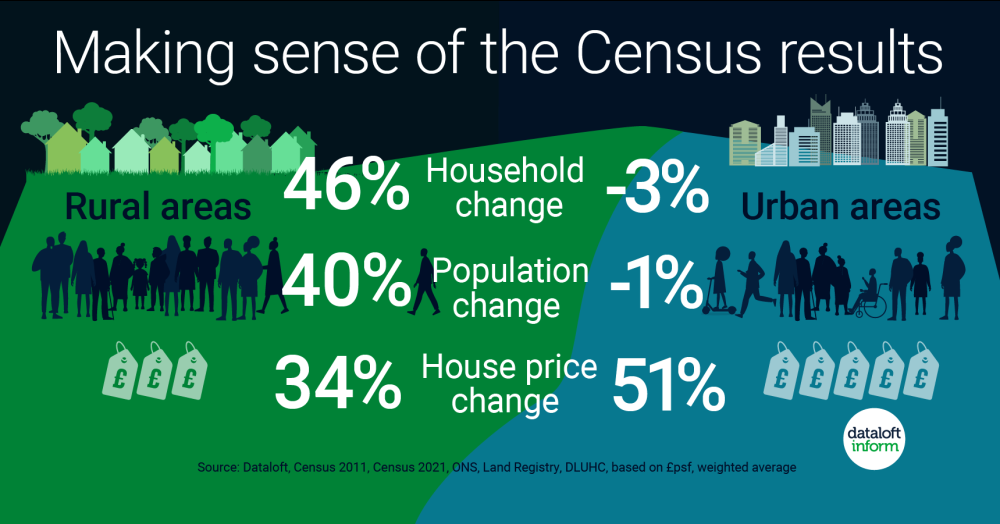
Making sense of the Census results
The first results of the 2021 Census published on June 28th show the population of England and Wales was 6% higher on Census day 2021, compared to Census day 2011. The number of households was also 6% higher.
- Over the same period property prices rose by an average of 57%, urban areas outperforming their rural counterparts.
- The majority (75%) of people live in urban areas but the rate of population and household growth in rural areas appears to be much higher due to the impact of the COVID-19 lockdown.
- Many students and young people returned home and households combined temporarily boosting the rural population.
- Since 1801 a census has taken place in England and Wales every 10 years, except for 1941. The 2021 Census is officially the 24th and a 'digital-first' census, the majority of responses were completed on-line. Source: Dataloft, Census 2011, Census 2021, ONS, Land Registry, DLUHC, based on £psf, weighted average