Housing supply: a ten-year retrospective
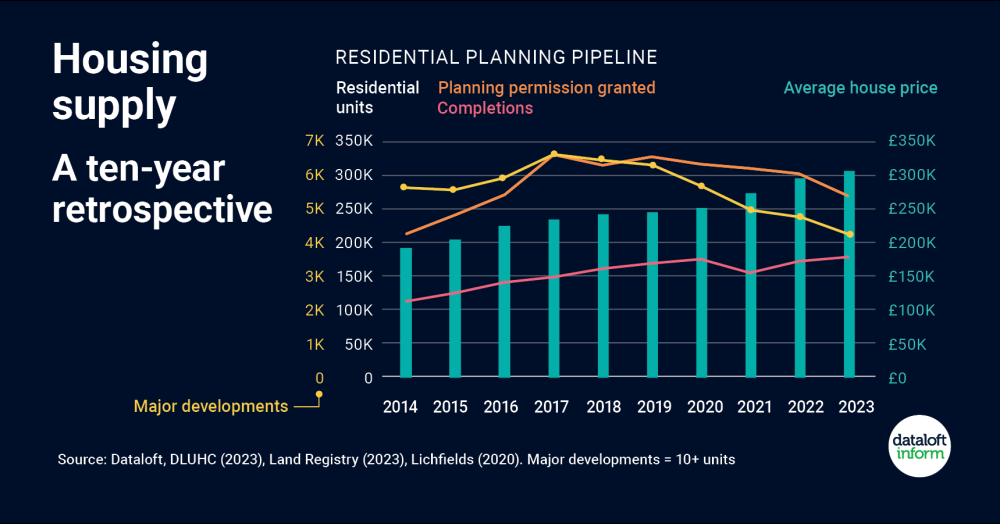
Recently-released statistics on planning applications show a steady decline in major residential approvals across the country since the peak of 6,617 back in 2017. We now sit at 4,221 major residential approvals, the lowest in 10 years.
- On a more positive note, the number of new homes is at a 10-year high with over 177,000 completed in the last 12 months, indicating that we're still benefitting from the peak of residential approvals between 2017–19.
- Research by Lichfields in 2020 found that developments of over 500 homes can take an average of 3 years to begin completions, with schemes of 200+ homes taking 8.4 years. This means we will still be benefitting from the 2017–19 peak in the immediate future.
- Over the last 10 years average house prices have steadily risen, seemingly unaffected by the residential planning pipeline for the time being. Source: Dataloft, DLUHC (2023), Land Registry (2023), Lichfields (2020)